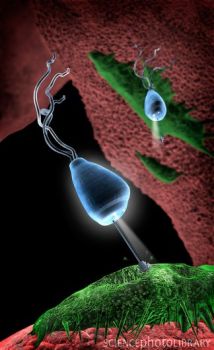
Nanorobots A nanorobot is a robot that is about the size of the cell which is composed of thousands of molecule-size mechanical parts that are as strong as a diamond. They are typically in the range of 0.1 - 10 micrometres in size. These incredibly small robots move with nanoscale precision. These microscopic nanorobots have the power to change the medical world. Society looks upon nanorobots to hopefully cure the impossible diseses in the near future. Nanorobots have not yet been successfully created yet, its future applications and its structure have been thoroughly thought out. The only complication that nanotechnology is very recent and it has not flourished enough to build a microscopic nanorobot. Nanorobots will most likely be amde of silicon because it is strong and can easily be manipulated to have various properties. The closest a person has come to creating a robot as small as a nanorobot is by Kris Pister at U.C Berkely who build a solar powered robot at 8.5 mm. Although the robot is very small it is still not near the size that a nanorobot would be. (Source 14) To learn more about Kris Pister's research click here. Possible application for nanorobots click here. | The video below is of a nanorobot killing bacteria. (Source Ac) The video below is a clip showing a medical nanorobot virtually. (Source Bc) |
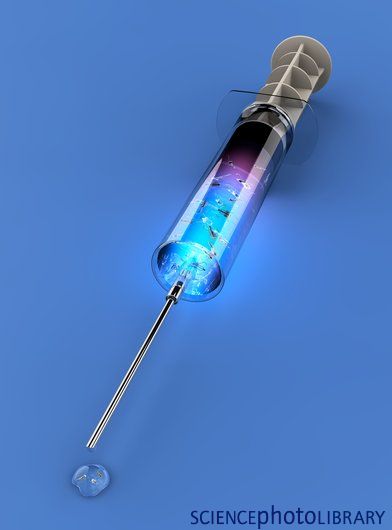
Photo (Source 6a) Nanorobots and cancer Cancer is the unusual and uncontrolled growth of cells that have the ability to migrate to other locations and spread out. Cancerous cells replicate faster than healthy cells, causing the elimination of metabolic waste products. Due to the fast growth of cancer cells the healthy cells can not compete for the nutrients needed and will eventually be replaced with tumor cells. With nanotechnology the fear of cancer will fade away with the development of a targeted drug delivery system that does not have as much toxic side effects as chemotherapy does. The challenge with creating such a robot is that it will need to have many certain tools and technologies to maneuver and not mistake a healthy cell as a cancerous cell. A way around this challenge is the thought of nanorobots that could tag the cancerous cells, so that the surgeon could precisely remove the tumor. Either way nanorobotics will help keep cancer stable and maybe in the future help find a cure. (Source 16) | Nanorobots in the medical world Nanotechnology manipulates structures and properties at nanoscale which changes the medical world entirely. The cost will decrease while the quality will increase because of the nano size. While it will be costly to build and test once the first is built it would be easy to copy. Examples of these surgical tools would include surgical robots that can be build smaller than a needle.There are many uses for nanorobots in the near future, but the most looked upon is their help for saving lives from dangerous diseases that have no hope today. Nanorobots are miniture with their length of a few micrometers but big powers. Not only are surgical tools being cut to nanometers of a size but, medical devices can be implanted permanently. Which can monitor a persons body and keep it balanced. These tiny medical devices will constantly record a person's state of health. This will cause more diseases and medical problems to be prevented because of the early detection. Many scientists as for Robert Freitas is finding new ways that nanotechnology can destroy or disable deadly pathogens. (Source 15)
|
l Home l Other Uses l Nanobots l Impacts l Innovators l Sources l
